Russian Blue Cat Characteristics: A Complete Guide to Physical Traits, Appearance & Unique Features (2026)
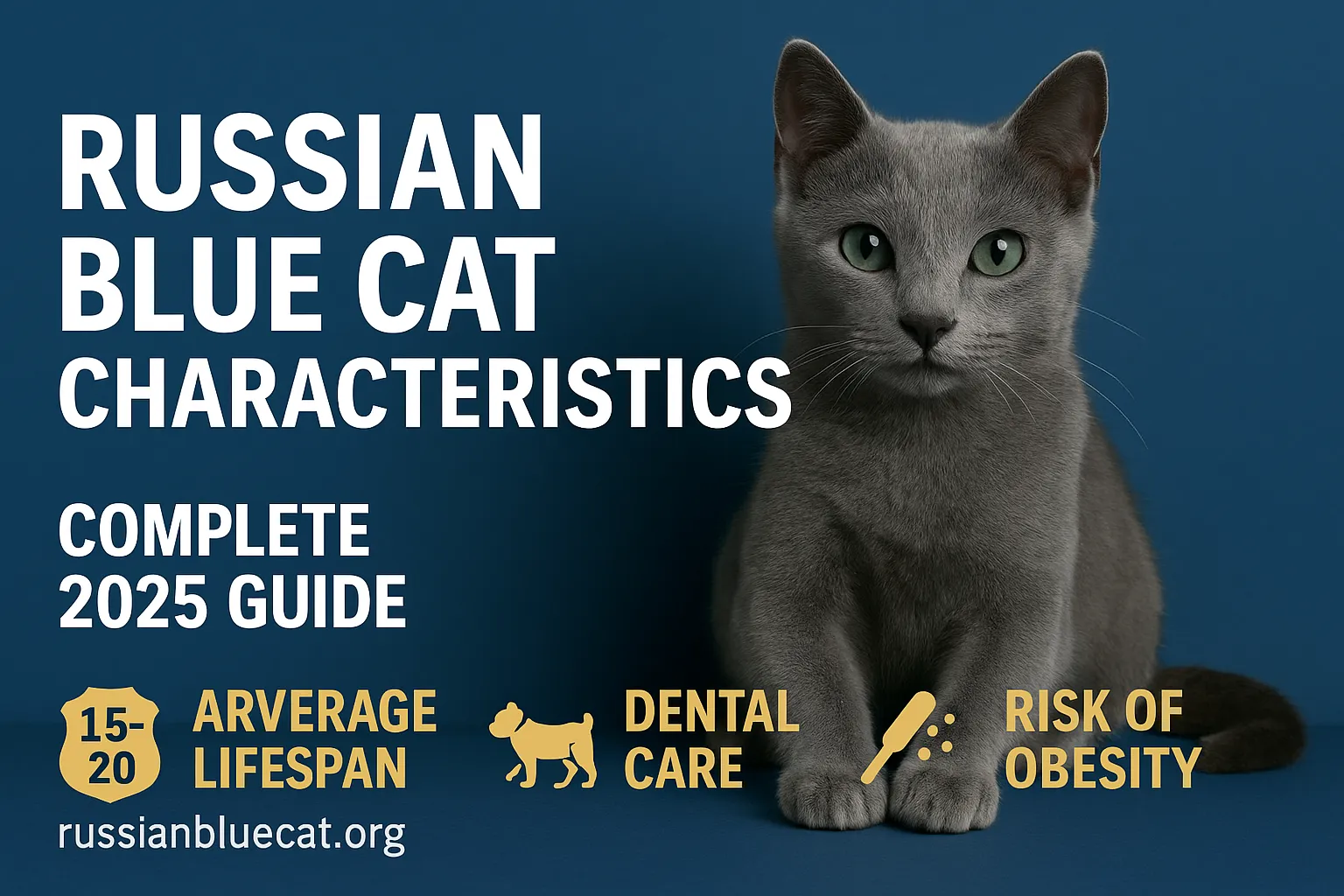
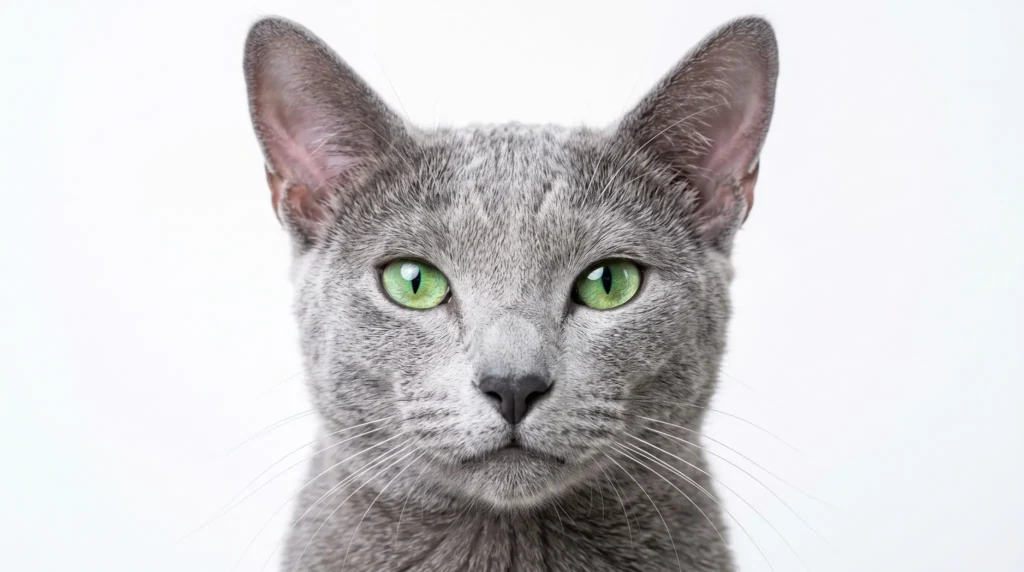
The Russian Blue is a medium-sized cat with a fine-boned but genuinely muscular build, a distinctive short double coat of solid blue-gray with silver-tipped guard hairs, vivid emerald-green eyes, a wedge-shaped head, large wide-set ears, and lavender-pink paw pads. No other domestic cat breed shares this exact combination of physical traits. Adults weigh 7–12 lbs and stand 8–10 inches tall, reaching full physical maturity between ages two and three.
Most people encounter a Russian Blue for the first time and assume the photographs were enhanced. The coat looks too precise, too silver, the eyes too green. Then they see one in person — ideally in direct sunlight — and realize the photographs actually undersell it.
The shimmer is real. Each guard hair has a silver tip, and when light moves across the coat, those tips catch it at slightly different angles simultaneously. The effect is not subtle. It is the kind of thing that makes people stop mid-sentence.
But the coat is only the beginning. The Russian Blue has a specific physical profile — head shape, eye color, body structure, paw pad color, whisker color — that is both distinctive and internally consistent. Understanding these characteristics matters practically: it helps you identify a genuine Russian Blue, understand what is normal for the breed, and recognize what makes this cat genuinely unlike anything else in domestic cat genetics.
This guide covers every characteristic in detail — what the CFA breed standard actually says in plain language, what experienced owners notice that guides never mention, and how to tell a purebred Russian Blue from the many look-alike cats that get misidentified online every day.
Russian Blue Characteristics at a Glance
| Physical trait | Details |
|---|---|
| Weight | Males: 10–12 lbs / Females: 7–10 lbs |
| Height | 8–10 inches at shoulder |
| Body type | Fine-boned, long, muscular — “foreign” type |
| Head shape | Medium wedge, flat skull, blunt muzzle |
| Coat length | Short |
| Coat texture | Dense double coat, plush, stands away from body |
| Coat color | Solid blue-gray with silver-tipped guard hairs |
| Eye color | Vivid emerald green (adults) / yellow-green (kittens) |
| Eye shape | Almond, wide-set |
| Ear size | Large, wide at base |
| Paw pad color | Lavender-pink or mauve |
| Nose leather | Slate gray |
| Tail | Long, tapering, proportionate to body |
| Maturity age | Full physical maturity at 2–3 years |
| Lifespan | 15–20 years |
The Russian Blue Coat — The Defining Characteristic
Everything about the Russian Blue coat is specific. Not just the color — the structure, the texture, the way it moves, the way it responds to touch. This is the characteristic that defines the breed more than any other single feature, and it is worth understanding properly.
Color
The color is described in the CFA breed standard as “blue” — which in cat show terminology means a solid blue-gray, not the brown-inflected gray of a British Shorthair or the dark charcoal of some other blue breeds. The Russian Blue sits in a specific range: medium blue-gray with a cool, slightly metallic quality that comes from the silver tips rather than pigmentation alone.
The silver tipping is what creates the shimmer. Each guard hair — the longer, coarser outer layer of the double coat — is tipped in silver at its end. When dozens of these silver tips catch light simultaneously at slightly different angles, the coat appears to glow from within. This effect is most visible in direct sunlight or bright indoor light and barely detectable in dim conditions. Owners who have only seen their cat in low light are sometimes genuinely surprised the first time they see it in afternoon sun.
One color only. No patterns, no points, no white markings, no tabby ghost striping. The CFA breed standard is explicit: the Russian Blue is a solid-colored cat. Any visible striping, spotting, or color variation is not consistent with breed standards.
Texture and Structure
The coat is a true double coat — a dense, soft undercoat beneath shorter guard hairs on top. The undercoat is thick enough that running a finger through the coat leaves a visible track that holds for a moment before springing back. This is the “footprint” effect that cat breeders and experienced owners describe — a physical property of coat density that sets the Russian Blue apart from single-coated short-haired breeds.
The coat stands slightly away from the body rather than lying flat. This is a function of undercoat density — the inner layer pushes the guard hairs outward, giving the coat a slightly lifted, plush quality that reads as luxurious without being long. Running a hand along the coat in the direction of growth produces a smooth, dense feel. Running it against the grain produces clear track marks.
This structure has a practical consequence most owners discover by accident: the Russian Blue coat makes the cat appear larger than it is. The dense undercoat fills out the silhouette, giving the impression of a more substantial frame. Pick one up and the weight often surprises you — lighter than expected. The coat created an optical illusion.
Seasonal Variation
The coat changes across seasons in ways most breed guides do not address. During late winter and spring, the undercoat sheds more heavily — the coat becomes slightly less dense for several weeks and may appear marginally lighter in color as some of the denser undercoat releases. By summer, the coat sits closer to the body. By autumn, the undercoat rebuilds and the characteristic plush fullness returns.
The shimmer is most intense in autumn and winter when the coat is at maximum density. Owners who first see the breed in summer sometimes wonder if they have the right cat — the winter coat is noticeably more striking.
The Russian Blue Eyes
The eyes are the second characteristic that stops people. Once a Russian Blue reaches adult eye color — vivid emerald green, fully saturated, almost backlit in quality — it is immediately recognizable. No other domestic cat breed consistently produces this specific shade at this intensity.
Color Development
Russian Blue kittens are not born with green eyes. They are born with blue-gray eyes that shift to yellow within the first weeks of life. The yellow deepens and the first signs of green appear around the pupil rim at roughly four months. Over the following months, the green spreads from the pupil outward, gradually replacing the yellow entirely.
Full adult eye color is typically established between twelve and eighteen months. Some individuals complete the transition earlier, some take slightly longer. The final color — when fully developed — is a vivid, saturated emerald green with no yellow remaining. The intensity of the green often deepens further with age into middle adulthood.
An adult Russian Blue with any yellow remaining in the iris is either still completing its color transition or, in rare cases, not a purebred Russian Blue. Yellow eyes in an adult Russian Blue are a breed characteristic inconsistency worth noting.
Shape and Set
The eyes are almond-shaped — not fully round, not narrowly oval, but a soft almond with slightly tilted outer corners. They are set wide apart on the face, which contributes to the breed’s characteristic open, alert expression. The wide set is also part of what makes the eye color so visually impactful — there is significant space between the eyes, and each one gets its full visual weight.
Combined with the slightly upturned corners of the mouth — which give the breed its famous “Mona Lisa smile” — the wide-set green eyes produce a facial expression that reads as quietly content, slightly amused, and perpetually observant all at once. It is a very particular look that Russian Blue owners describe with remarkable consistency.
Head Structure and Facial Features
The Wedge
The CFA breed standard describes the head as a “smooth, medium wedge” — neither long and tapering like a Siamese nor short and round like a British Shorthair. The top of the skull is flat and long, descending gently toward the eyes, then continuing in a nearly straight line to the tip of the nose.
In profile, this produces a clean, angular silhouette. The forehead is broad and flat. The muzzle is blunt — rounded at the end rather than pointed — and forms part of the overall wedge shape without a sharp break or whisker pinch. The chin is firm and strong.
The result is a head that looks regal without being extreme. There are no exaggerated features in this breed — no pushed-in face, no unusually elongated muzzle, no dramatic facial structure. The Russian Blue is a naturally proportioned cat, and the head reflects this.
The Smile
The slightly upturned corners of the mouth are a genuine breed characteristic — not individual variation. Every Russian Blue has them to some degree, and they produce the impression of a permanent gentle smile even when the cat is completely expressionless. Combined with high whisker pads — the rounded, prominent areas where whiskers emerge — the facial expression is distinctive enough that experienced owners can identify the breed from across a room.
Whisker Color
This detail appears in almost no breed guide: the whiskers of a purebred Russian Blue are white. Not gray-tipped, not translucent — solid white. Against the blue-gray face, white whiskers stand out clearly. This is a consistent physical characteristic of the breed and one of the small identifying details worth checking when assessing whether a cat is a genuine Russian Blue.
Ears
Large, wide at the base, with slightly rounded tips that angle slightly forward. Set high and wide on the head. The ear leather is thin — the ears are almost translucent when backlit — which gives them a delicate quality despite their size. The inside of the ear has very little furnishing hair, making them appear particularly clean and open.
The ear set contributes significantly to the breed’s alert, attentive expression. Even a resting Russian Blue looks like it is paying attention — and usually, it is.
Body Structure — Fine-Boned But Genuinely Muscular
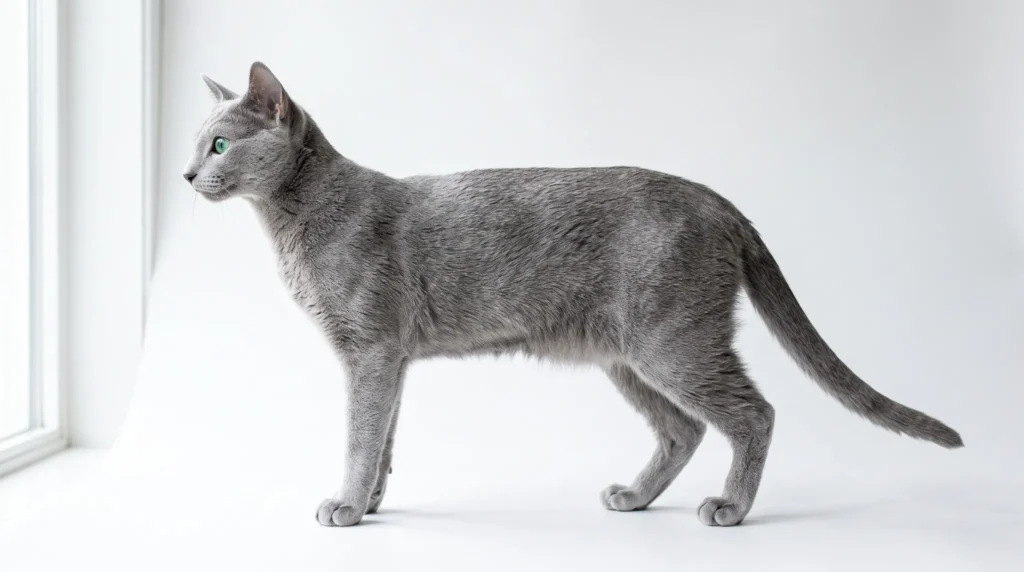
The Russian Blue body type is what cat breeders call “foreign” — a term meaning long, elegant, and fine-boned, as opposed to the compact, rounded “cobby” body type of breeds like the British Shorthair or Persian.
Long legs. Long neck. A long body that is lean and graceful in silhouette. Fine bone structure that makes the cat appear light and athletic. And then you pick it up and discover there is significant muscle mass under that coat that the silhouette completely concealed.
This combination — fine bones, genuine muscle, low body fat, dense coat — produces a cat that is simultaneously lighter than it looks when you see it and heavier than it looks when you expect to lift it. The disconnect between visual expectation and actual weight is something nearly every Russian Blue owner mentions at some point.
The chest is moderate — neither barrel-chested nor narrow. The abdomen is firm. In a cat at healthy weight, the ribs should be palpable with light pressure but not visible. A Russian Blue at proper body condition has a clear waist definition when viewed from above and a slight abdominal tuck when viewed from the side.
Legs and Paws
Long legs, fine-boned but strong, with the hind legs slightly longer than the front — which gives the breed a very slight upward tilt to the hindquarters that is just perceptible in a standing cat. The paws are small and rounded, almost dainty relative to the leg length.
The paw pads are lavender-pink or mauve — one of the most distinctive and least-discussed physical characteristics of the breed. In most domestic cats, paw pads are pink or dark gray. The Russian Blue’s lavender-mauve pads are a specific breed trait that appears consistently in purebred cats. Once you notice this detail, you cannot un-notice it, and it becomes one of the fastest verification points when assessing whether a blue-gray cat is a genuine Russian Blue.
Tail
Long and tapering, proportionate to body length. The tail base is not thick — it is consistent with the fine-boned body type. The tail narrows gradually toward a pointed tip. In a relaxed cat, the tail is carried low and sweeping. An alert Russian Blue carries it at a slight upward angle.
Russian Blue Characteristics vs Similar Breeds — How to Tell Them Apart
This is the section most owners need and most guides skip entirely.
| Feature | Russian Blue | Nebelung | British Blue | Chartreux |
|---|---|---|---|---|
| Coat length | Short | Long, silky | Short | Medium-short |
| Coat texture | Dense double, stands away | Long, flowing, soft | Dense, crisp | Dense, woolly |
| Body type | Fine-boned, long, foreign | Fine-boned, long | Compact, cobby | Compact, muscular |
| Eye color | Vivid emerald green | Vivid green | Orange to copper | Gold to copper |
| Paw pad color | Lavender-pink | Lavender-pink | Pink | Gray-blue |
| Whisker color | White | White | Pink/translucent | White |
| Head shape | Medium wedge | Medium wedge | Round, broad | Round, broad |
| Ear size | Large, wide-set | Large, wide-set | Medium, wide-set | Medium, slightly tilted |
| Weight | 7–12 lbs | 7–11 lbs | 9–17 lbs | 6–12 lbs |
| Smile expression | Yes — upturned mouth corners | Less pronounced | No | No |
The most reliable identification points for a Russian Blue specifically: emerald green eyes in adults, lavender-pink paw pads, white whiskers, wedge-shaped head, and the silver-tipped double coat that stands slightly away from the body. The Chartreux and British Blue share coat color but have completely different eye colors, body types, and head shapes. The Nebelung shares body type and eye color but has a completely different coat length.
How the Russian Blue’s Physical Characteristics Connect to Its Personality
This connection is rarely made explicit, but it is genuinely interesting.
The large, wide-set ears are not just visual features — they are functional. The Russian Blue’s hearing is acute, and those large ears positioned high on the head catch sound from a wide angle. This is part of why Russian Blues are so observant. They are hearing more of what is happening in their environment than their relaxed posture suggests.
The wide-set eyes with a broad field of vision contribute to the same observational tendency. This is a cat built to watch — physically equipped for the careful, constant environmental monitoring that defines its personality.
The fine-boned but muscular body reflects the breed’s origin in working ship conditions. This was not a lap cat bred for decorative purposes. It was a functional cat bred in demanding conditions — and the body shows it. Lean, agile, genuinely strong, built for movement and quick response.
The coat’s density — built for Arctic port conditions in northern Russia — is part of why the breed runs slightly warmer than some other cats and tends to seek out cooler sleeping spots in warm weather. The insulation that served them in Arkhangelsk is still very much present.
For more on how these physical characteristics express themselves in daily behavior, the Russian Blue cat personality guide covers temperament, bonding patterns, and communication in detail.
How to Identify a Purebred Russian Blue
The combination of features that identifies a genuine purebred Russian Blue:
Must have all of these:
- Solid blue-gray coat with silver tipping — no patterns, no markings
- Short, dense double coat that stands slightly away from body
- Vivid emerald green eyes in adults
- Lavender-pink or mauve paw pads
- White whiskers
- Wedge-shaped head with flat skull
- Large, wide-set ears set high on head
- Fine-boned but muscular body — foreign type
- Upturned mouth corners — the “smile”
- Slate gray nose leather
Common misidentifications:
Mixed-breed cats with blue-gray coats are frequently marketed or described as Russian Blues. The two fastest checks: paw pad color and eye color. A blue-gray cat with pink paw pads and yellow or copper eyes is not a Russian Blue. Paw pads that are distinctly lavender-mauve and adult eyes that are genuinely emerald green, combined with the correct coat texture and body type, are the markers that matter.
DNA testing through services like Basepaws provides definitive confirmation when visual assessment is uncertain.
Russian Blue Characteristics Through Life Stages
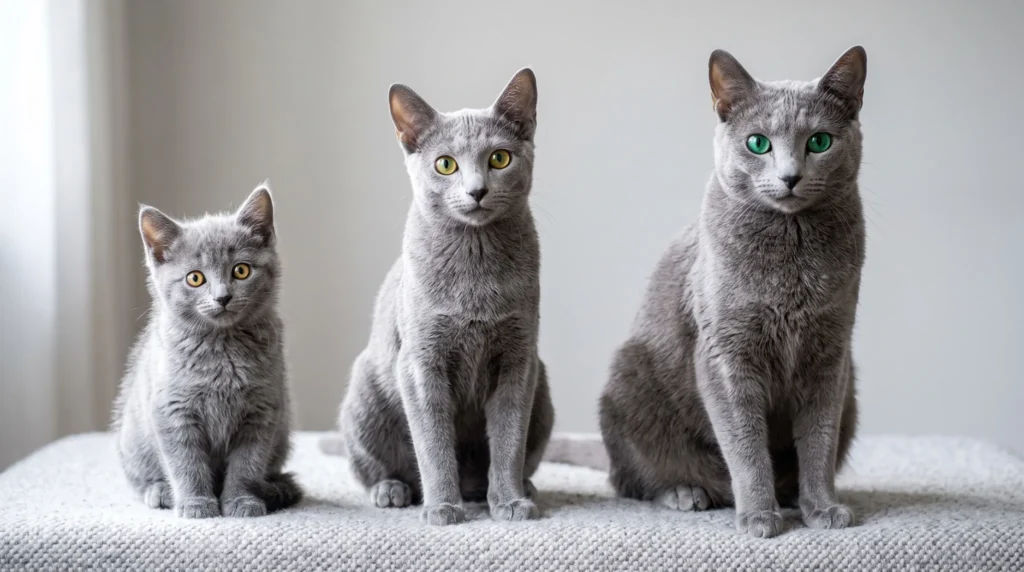
Kittens (0–6 months)
Blue-gray coat present from birth but finer in texture — the adult double coat density develops gradually. Eyes yellow at birth, shifting toward yellow-green around four months. Body proportions may look slightly ungainly — the legs seem long relative to the body before full growth fills out the frame. Whiskers white from early kittenhood.
Adolescent (6–18 months)
Eye color actively transitioning — this is the most variable period. Green spreads from pupil rim outward. Coat density increasing toward adult texture. Body filling out with muscle. The adult wedge head shape becomes more defined as the skull broadens slightly.
Adult (18 months–7 years)
Full characteristics established. Eye color at maximum intensity. Coat at full adult density and shimmer. Body at correct weight and muscle tone. This is the period when the breed looks exactly as it should.
Senior (7+ years)
The muzzle may develop a slight lightening of coat color with age — some silver-white hairs appearing around the face. Eye color typically remains vivid but may develop a very slight softening. Body weight requires more active management to maintain. Coat may become marginally less dense in very old cats but retains its characteristic texture well into senior years.
Pros and Cons of Having a Russian Blue
Frequently Asked Questions
Final Thoughts
The Russian Blue is one of those rare animals where the physical reality matches and then exceeds the description. Every characteristic — the silver shimmer, the emerald eyes, the lavender paw pads, the quiet upturned smile — combines into something that is genuinely greater than the sum of its parts.
These are not arbitrary aesthetic features. They are the product of a naturally occurring breed shaped by centuries of northern Russian climate, ship life, and genetic selection without human intervention. The coat that shimmers is the same coat that kept these cats warm in Arkhangelsk ports. The observant eyes and large ears are the same tools that made them effective working cats. The fine-boned muscle is the same build that made them agile and functional.
Understanding the characteristics of this breed is not just about identification — it is about appreciating what you are looking at. And what you are looking at, when you see a Russian Blue in the right light, is genuinely something.
For a complete picture of this breed including care requirements and health information, the Russian Blue cat Grooming covers everything from grooming the distinctive double coat to managing the breed’s specific health considerations.