
Russian Blue Cat Personality: Temperament, Behavior Traits & What to Really Expect
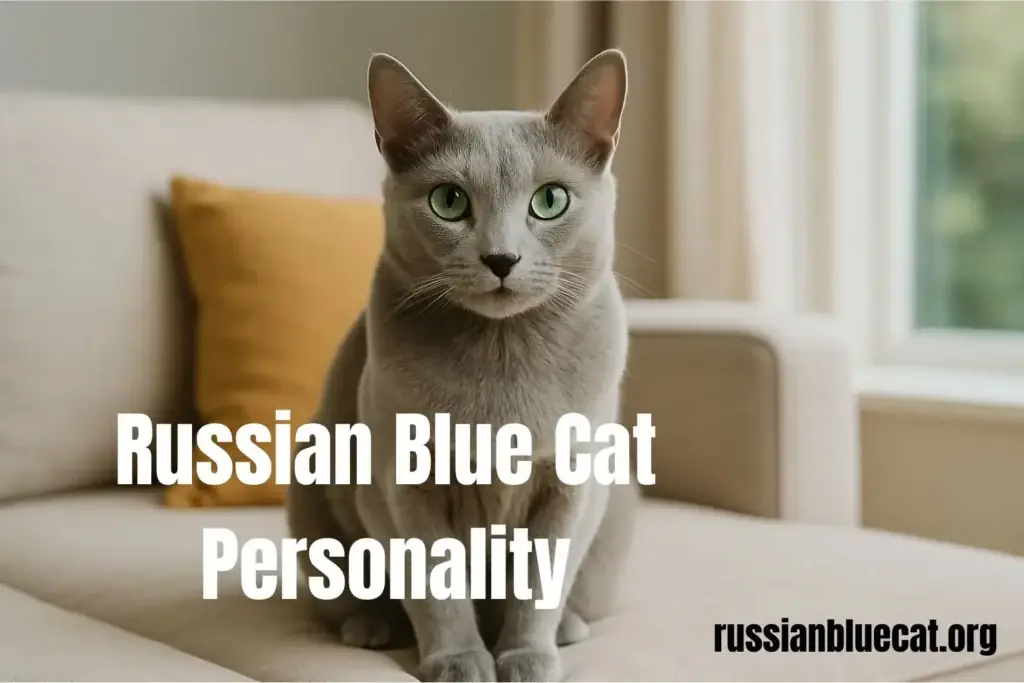
Most people come for the coat. That silver-blue shimmer, those green eyes — the Russian Blue is objectively one of the most striking cats alive, and photographs do not lie about that part.
What photographs cannot capture is the personality. And the personality is the real reason Russian Blue owners become, without exception, Russian Blue people for life.
I have spoken to dozens of owners over the years and the story is always some version of the same thing: they got the cat for how it looked, they stayed for who it was. A cat that watches more than it performs. A cat that takes time to trust — and then trusts completely. A cat that notices when something is wrong in the house before you have said a word about it.
This guide covers Russian Blue personality in full — the traits everyone mentions, the ones nobody warns you about, the differences between males and females, how personality changes across life stages, and how to know whether this breed actually fits your life.
What is the Russian Blue cat personality?
The Russian Blue cat personality is defined by quiet loyalty, emotional sensitivity, and a strong preference for routine. Reserved with strangers but deeply affectionate with trusted family members, Russian Blues form intense one-person bonds, communicate through body language rather than vocalization, and thrive in calm, predictable environments. They are not needy — but once they choose you, that bond is genuine and lifelong.
Russian Blue Cat Personality at a Glance
| Trait | Rating | Notes |
|---|---|---|
| Affection with family | ★★★★☆ | Deep but understated — not a lap cat by default |
| Friendliness with strangers | ★★☆☆☆ | Cautious to withdrawn — often hides during visits |
| Playfulness | ★★★★☆ | Intelligent play, prefers interactive over solo |
| Vocalization | ★★☆☆☆ | Very quiet — communicates mostly through body language |
| Adaptability | ★★☆☆☆ | Low — routine disruption causes visible stress |
| Independence | ★★★★☆ | Handles alone time well but forms strong bonds |
| Intelligence | ★★★★★ | Among the highest of domestic breeds |
| Energy level | ★★★☆☆ | Moderate — active in bursts, calm at rest |
| Good with children | ★★★☆☆ | Better with older, calm children than toddlers |
| Good with other pets | ★★★☆☆ | Fine with slow introductions, dislikes chaos |
The Core Russian Blue Personality — What This Breed Is Really Like
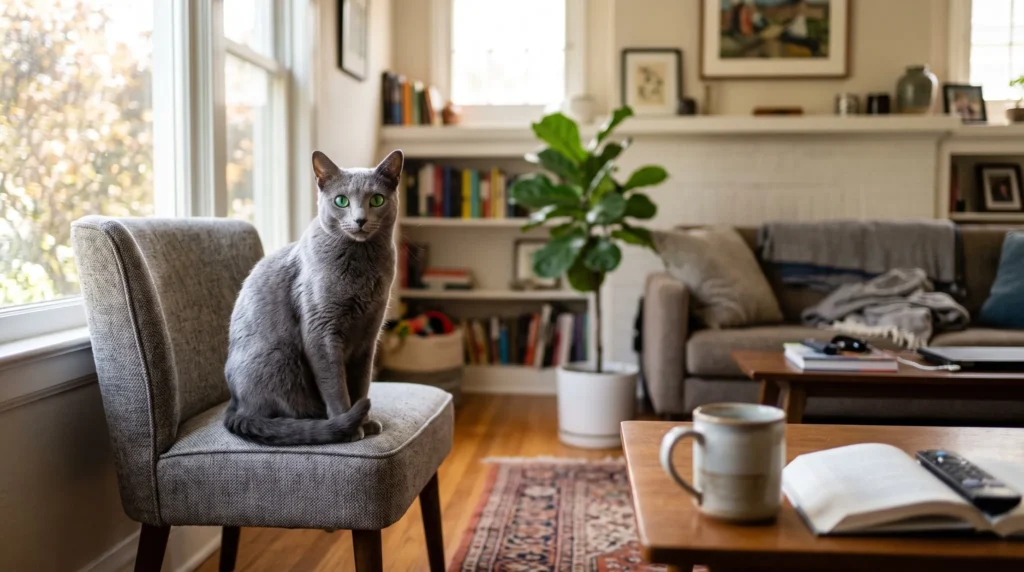
The Russian Blue is not the cat for someone who wants instant, unconditional warmth. It is the cat for someone who understands that trust is something earned, not assumed.
New Russian Blue owners often describe the first few weeks as puzzling. The cat watches. It observes from a distance. It maps your habits — when you wake up, where you sit, how loud your household actually is — before it makes any decision about you. This is not standoffishness. It is caution built into the breed over centuries of history as a working ship cat in northern Russia. Selective wariness kept them alive. It is still in them.
Then, somewhere between week two and week six for most owners, something shifts. The cat starts following you. Not desperately — quietly. It appears in whatever room you move to. It sits just close enough. And one day, without ceremony, it puts its head on your leg and closes its eyes.
That moment. That is the Russian Blue personality in its entirety.
What makes this breed genuinely different from other loyal cats is the quality of the attention they give. Russian Blues are observant in a way that most cats simply are not. They watch your face. They notice your posture. Research published in Applied Animal Behaviour Science confirms that domestic cats, particularly intelligent breeds with elevated problem-solving tendencies, develop sophisticated behavioral reading skills through close cohabitation with humans. The Cat Fanciers’ Association (CFA) also describes the Russian Blue as an intelligent, gentle, and reserved breed that forms strong bonds with its family. Russian Blue owners will tell you this without being prompted—this breed knows when something is off before you have said anything.
Calm, precise, and absolutely certain about who they have decided to love. That is the Russian Blue.
Russian Blue Temperament With Family Members
With Their Chosen Person
The Russian Blue typically bonds most intensely with one person in the household. This is not aggression toward others — it is preference. The chosen person gets the door greeting every single day without exception. The sustained eye contact from across the room. The slow blink — which in cat communication is the equivalent of a declaration of trust. The quiet presence in whatever room they occupy.
According to Hill’s Pet Nutrition, Russian Blues “have a tendency to attach to one pet parent in particular” while still demonstrating affection with the whole family. This is accurate in practice, though the intensity of the primary bond is often understated in breed summaries.
What they give their chosen person is difficult to describe accurately. It is not the frantic devotion of a dog, not the loud affection of a Siamese. It is steadier than both. More considered. The Russian Blue does not love loudly. It loves consistently.
With Other Household Members
With the rest of the family — children, partners, other frequent residents — the Russian Blue is affectionate but more measured. They will accept petting, seek out warmth on cold evenings, and participate in household life. They simply will not prioritize these people the way they prioritize their chosen person.
This can occasionally cause friction in households where multiple people expected equal devotion. Worth knowing before you bring one home.
With Children
Russian Blues are patient with calm, gentle children. They rarely become aggressive — more commonly they simply leave when they have had enough interaction. The issue is the leaving part. A young child who does not read feline body language will continue trying to engage a cat that has clearly communicated it is done. This combination — persistent child, dignity-prioritizing cat — does not always end well.
With older children who have been taught to read animal cues, Russian Blues can form strong bonds. The key word is calm. This is not a breed for chaotic, loud households with toddlers running at full speed through the house. That environment produces a stressed, withdrawn Russian Blue rather than the gentle companion the breed is capable of being.
Russian Blue Cat Behavior With Strangers
This is where most people get caught off guard.
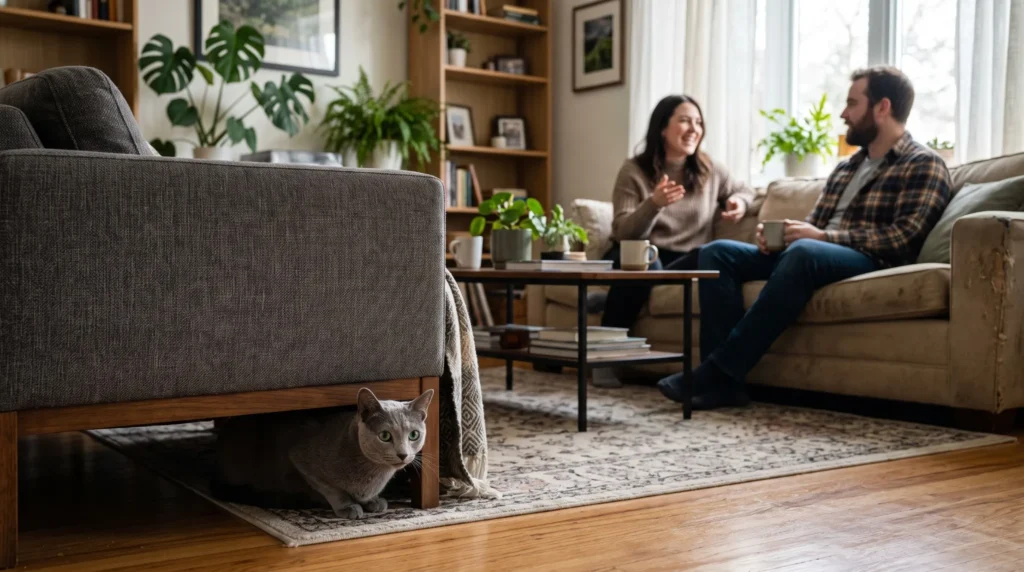
You have been told the Russian Blue is sweet and affectionate. Your guest arrives. The cat disappears entirely. You cannot find it for two hours.
This is normal. Completely normal. Expected, in fact.
Russian Blues categorize people quickly and conservatively: known and safe, or unknown and therefore uncertain. Strangers fall in the second category until proved otherwise. The disappearing act is not fear exactly — it is judgment suspension. The cat is watching from somewhere you cannot see, gathering information, deciding.
What to tell guests: do not approach the cat. Do not make direct eye contact. Do not make loud sounds or sudden movements. Sit down, speak quietly, and let the cat determine the timeline. With genuinely calm, patient visitors, many Russian Blues will investigate within 30–45 minutes. Some will not fully warm up during a single visit.
The cat that never shows itself during parties and dinners but sleeps across your feet every night is not a broken cat. It is a Russian Blue behaving precisely as designed.
Russian Blue Intelligence and Problem-Solving
This is one area where the breed genuinely surprises people who were not expecting it.
Russian Blues are not just smart for a cat. They are smart in ways that produce observable, sometimes inconvenient behavior.
They learn routines faster than you do. A Russian Blue can predict your feeding schedule to within minutes and will remind you — not loudly, but pointedly — if you are running late. They figure out door mechanisms. They remember where you put things. They observe you solving a problem once and will attempt the same solution themselves.
Puzzle feeders are not optional enrichment for this breed — they are a genuine need. A Russian Blue without adequate mental stimulation does not become destructive in the way a Bengal or Abyssinian might. Instead, it becomes anxious. Withdrawn. The intelligence that has no outlet turns inward and becomes stress.
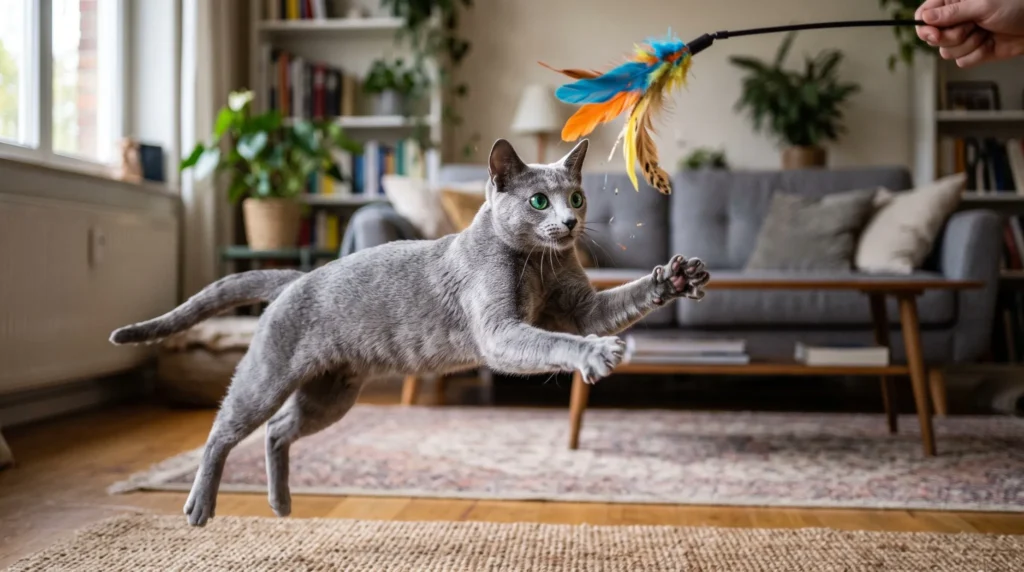
Interactive toys — wand toys with feathers, puzzle feeders with hidden compartments, even DIY cardboard box mazes — keep this breed at its best. Twenty minutes of focused interactive play daily does more for a Russian Blue’s wellbeing than hours of solo access to a toy ball.
Many Russian Blues will also learn commands. Sit, paw, come, and fetch — yes, fetch — are all achievable with patient treat-based training. Short sessions of five minutes, once or twice daily, started young. Their intelligence makes them faster learners than most people expect from a cat.
Russian Blue Vocalization — What Their Silence Actually Means
The Russian Blue is one of the quietest domestic cat breeds. Day to day, in a settled household, you may go hours without hearing a sound from them.
This is not absence of communication. It is a different communication channel.
Russian Blues communicate primarily through body language. The slow blink means trust and comfort. Ears slightly forward means relaxed attention. Ears flattened sideways means stressed or overstimulated — give space immediately. A tail carried low and slow means content. A rapidly flicking tail tip means something is wrong.
The vocalizations they do produce are soft: a trill, a chirp, an occasional quiet meow when asking for food or attention. When a Russian Blue meows loudly or persistently, pay attention. That is not normal behavior for this breed. Loud, sustained vocalization from a Russian Blue is communication that something is actually wrong — pain, illness, extreme stress, or an empty bowl that has been empty longer than acceptable.
One sound that surprises new owners: the chirp. Russian Blues produce a distinctive chirping sound, particularly when watching birds through a window. It is somewhere between a meow and a trill, completely involuntary, and one of the most endearing things about the breed.
Male vs Female Russian Blue Personality — The Real Differences
Most breed guides skip this entirely. It matters.
| Factor | Male Russian Blue | Female Russian Blue |
|---|---|---|
| Affection style | More openly affectionate, more likely to be a lap cat | More selective, more reserved overall |
| Bonding | Bonds broadly with household | Bonds intensely with one person |
| Stranger behavior | Slightly more curious | More cautious, withdraws faster |
| Playfulness | Higher energy, more extended play sessions | More focused, shorter but intense play |
| Vocalization | Marginally more vocal | Quieter on average |
| Independence | Less — prefers company | More — comfortable with alone time |
| Territorial behavior | More pronounced without neutering | Less so regardless |
These are tendencies, not guarantees. An individual cat’s socialization history matters as much as sex. A male raised in a chaotic environment will be more anxious than a well-socialized female. But if you are choosing between a male and female Russian Blue and you want a lap cat, lean male. If you want a more self-contained, quietly devoted companion, lean female.
Spaying and neutering significantly reduces the behavioral differences between sexes. The distinctions above are most pronounced in intact cats.
Russian Blue Personality Through Life Stages
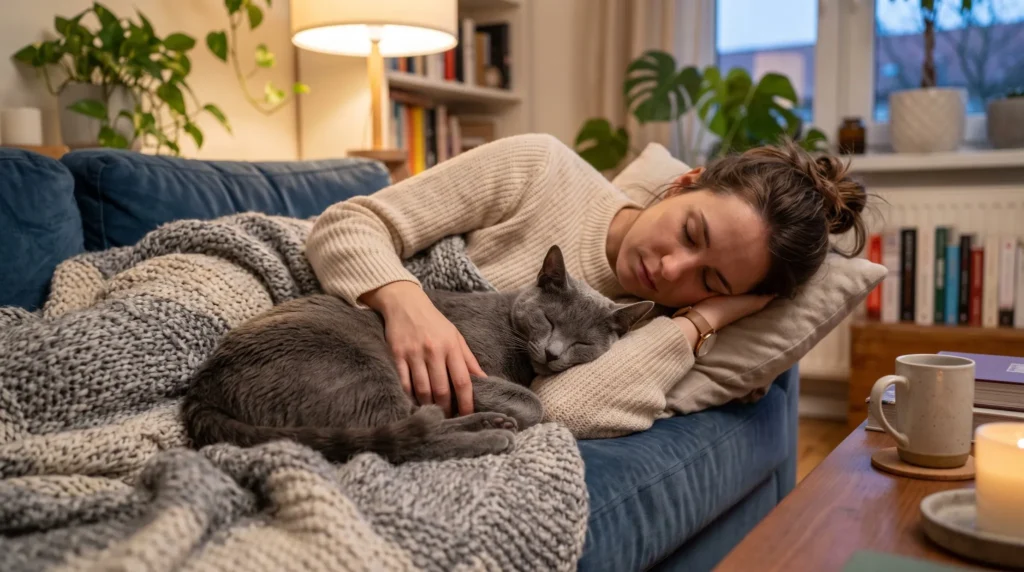
This is the section almost no breed guide covers — and it matters, because the cat you bring home as a kitten is not the same personality you will live with at age ten.
Kitten Stage (0–12 months)
Russian Blue kittens are more playful and energetic than their adult reputation suggests. They sprint, they climb, they investigate everything, they play hard and then sleep hard. The wariness with strangers is present but less pronounced young kittens are curious in a way that softens their natural caution.
This is the most flexible period for socialization. Kittens exposed to a variety of calm, respectful people during months two through six will be meaningfully more comfortable with strangers as adults. Do not skip this window.
The kitten personality can mislead people into expecting a consistently sociable adult. The reserve tends to deepen as they mature. This is normal.
Young Adult (1–5 years)
The personality you will live with for most of the cat’s life emerges and stabilizes here. The primary bond is established. Routines are set. The wariness with strangers reaches its adult level. Intelligence peaks — this is when puzzle toys, training, and mental enrichment matter most.
Energy is moderate but real. Daily interactive play is essential during this period. A young adult Russian Blue without adequate stimulation will find its own entertainment, and its choices may not match yours.
Mature Adult (5–10 years)
Calmer. More settled. The bond with their chosen person deepens further. Play remains important but sessions may be shorter. The routine sensitivity remains — do not expect a middle-aged Russian Blue to adapt more easily to change than a younger one. If anything, the opposite.
This is often described by owners as the breed’s best period. The wariness has fully settled into a predictable pattern. The affection is established and consistent. The intelligence is engaged but not frantic.
Senior (10+ years)
Senior Russian Blues become noticeably quieter and more sedentary. Sleep increases significantly. The bond with their person often intensifies — they want proximity more than they want play. Health monitoring becomes more important: weight, dental health, joint comfort, kidney function.
Their emotional sensitivity does not diminish with age. Senior Russian Blues remain attuned to household mood and continue their door-greeting behavior well into old age, sometimes right up until the end of their lives.
Russian Blue Personality Myths — Debunked
Myth 1: “Russian Blues are cold and unfriendly.”
Wrong. They are reserved, not cold. The distinction is significant. Cold means indifferent. A Russian Blue is never indifferent to its chosen people — it is simply precise about who gets its attention and when. Once trust is established, the warmth is genuine and consistent.
Myth 2: “A Russian Blue that hides from guests is antisocial and poorly adjusted.”
Also wrong. Hiding from strangers is species-appropriate behavior for a cautious, observant cat. It is not a socialization failure. A Russian Blue that removes itself from an overwhelming situation is making a healthy, self-regulating choice. Forcing it to “perform” for guests causes stress without any lasting benefit.
Myth 3: “Russian Blues need constant entertainment or they get destructive.”
Partially wrong. They need mental stimulation, yes — but not constant chaos. The Russian Blue wants purposeful enrichment: a puzzle feeder, a wand toy session, a window with a view. They do not need high-energy free-for-all play the way some breeds do. Quality over quantity, always.
Myth 4: “All Russian Blues are the same.”
No. Breed personality is a tendency, not a template. Socialization history, early environment, and individual variation produce meaningfully different cats within the same breed. Two Russian Blues from different breeders, raised in different households, can have noticeably different personalities while still sharing the core traits of the breed.
Is the Russian Blue Personality Right for You?
Be honest with yourself here. This matters.
This personality fits you if:
- You want a cat that bonds deeply with you specifically
- You live alone or in a quiet household
- Your home has a consistent daily routine
- You respect animal boundaries and do not need your cat to perform for others
- You are patient enough to let trust develop at the cat’s pace
- You find quiet companionship as satisfying as demonstrative affection
This personality will frustrate you if:
- You want a cat that is friendly and engaging with every visitor
- Your household is loud, chaotic, or frequently disrupted
- You have young children who are not yet able to read animal body language
- You need constant visible affection to feel connected to your pet
- Your work schedule makes a consistent daily routine difficult
There is no shame in either category. The wrong cat for your life is a disservice to both of you. The Russian Blue is not a universal fit — it is a very specific, deeply rewarding fit for the people it matches.
Frequently Asked Questions
Final Thoughts
The Russian Blue personality is not for everyone. That is not a criticism — it is precision.
This is a cat that takes its time with trust, keeps its own counsel with strangers, and gives its chosen person something that is genuinely difficult to describe: the feeling of being truly seen by an animal that does not give that away easily.
Fifteen to twenty years of that. Quiet, consistent, completely genuine.
Not for everyone. For the right person, nothing compares.